Hormonal Health
·12 min read
10 Ways to Raise Testosterone Naturally with Supplements
A precision-medicine field guide for executives, aging athletes, and anyone who would rather fix the root cause than chase a proprietary blend. Ranked by evidence, quantified in nanograms, and personalized to your genome.
By Tony Medrano & Tobias Young, IFBB Pro
The uncomfortable opening
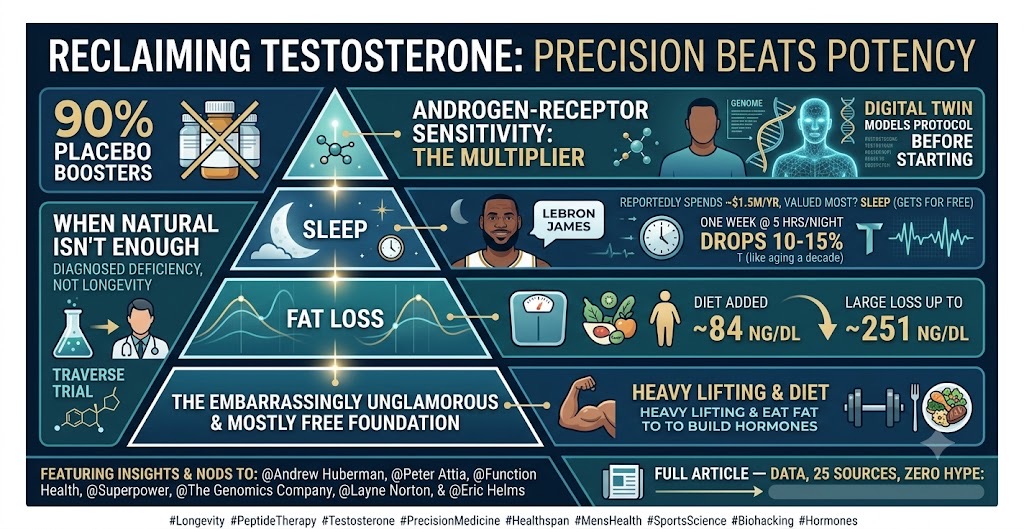
Roughly 90% of the testosterone "boosters" on the shelf are, to put it plainly, expensive placebos — underdosed proprietary blends sold to men anxious about a number they have never measured.1 That is the bad news. The better news is more interesting: a handful of interventions genuinely move testosterone, and the ones with the strongest data are almost embarrassingly unglamorous. Sleep. Body fat. A barbell. Correcting a deficiency you didn't know you had.
Here is a useful way to picture it, borrowed from the most-studied body in professional sports. LeBron James reportedly spends around $1.5 million a year maintaining his physiology — cryotherapy, hyperbaric chambers, the works. Ask him what matters most, and he doesn't name any of it. The most important thing he gets for free, his longtime trainer Mike Mancias says, is sleep. Sports scientists describe James's approach as a pyramid, with cheap, evidence-rich fundamentals at the base and flashier, less-proven technology near the tip.4 That pyramid is the correct mental model for testosterone, too — and it is exactly upside-down from how the supplement aisle is organized.
What follows are the ten most defensible ways to raise testosterone naturally, arranged from the base of that pyramid upward. One number sets the stakes: after roughly age 30, testosterone drifts down about 1–2% per year.2 That is the slow tide you can't stop. Almost everything below is about the far larger part of the tide you can.
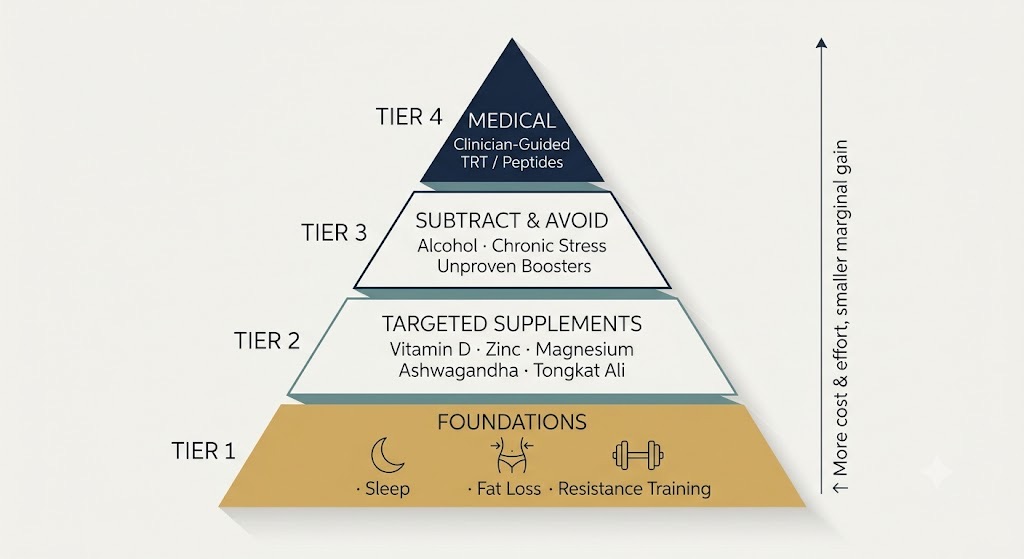
The testosterone pyramid: the biggest, most reliable gains sit at the base and cost the least. Supplements and medical therapy help — but only after the foundations are in place.
Movement I — The levers that cost nothing (and beat the pills)
1. Fix your sleep — the most reversible lever there is
The effect size here is startling. In a tightly controlled University of Chicago study, healthy young men (average age 24) had their sleep cut to five hours a night for one week. Their daytime testosterone fell 10–15% — a drop the investigators equated to aging 10 to 15 years.3 Most of a man's daily testosterone is released during sleep, so fragmenting it isn't a lifestyle footnote; it's an endocrine intervention with the sign flipped. Eve Van Cauter, PhD, who led the work, called poor sleep an endocrine disruptor.3
This is why James, now performing at an elite level at 40, hits the sack at 9 p.m. and logs eight to ten hours, and why obstructive sleep apnea — far more common in men and wildly underdiagnosed in high-achievers who mistake it for "just being tired" — deserves a real workup. For the founder treating four hours as a badge of honor, this is the highest-yield hormonal move available, and no capsule can outrun it.
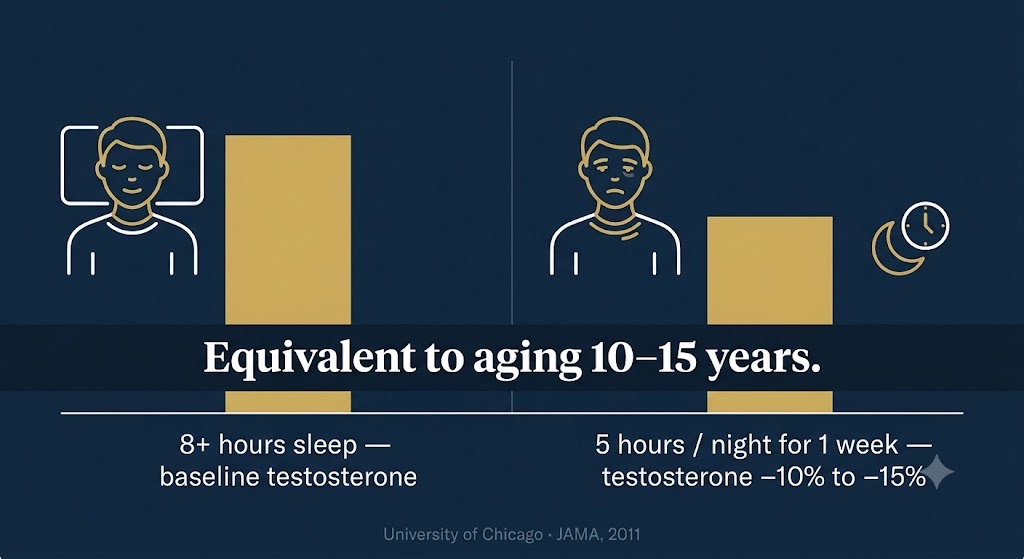
Cutting sleep to five hours a night for a single week dropped healthy young men's daytime testosterone by 10–15% — the hormonal equivalent of aging a decade or more.
2. Strip visceral fat — the biggest chemical lever
Adipose tissue runs on aromatase, the enzyme that converts testosterone into estradiol. More visceral fat means more of your testosterone is quietly siphoned off, while inflammation and insulin resistance dampen the whole hypothalamic–pituitary–testicular axis.5 Lose the fat, and you release both brakes at once.
The numbers are specific. In a meta-analysis led by Giovanni Corona, a low-calorie diet producing roughly 10% weight loss raised total testosterone by about 2.9 nmol/L (~84 ng/dL); the far larger weight loss from bariatric surgery (~32%) raised it by about 8.7 nmol/L (~251 ng/dL) — and the amount of weight lost was the single best predictor of how much testosterone returned.5 For a man sitting at 350 ng/dL and 30% body fat, that is not a rounding error; it can be the difference between symptomatic and fine, achieved without a prescription. The lever is the fat itself, not the method, which is why the fat loss now driven by GLP-1 medications from Eli Lilly and Novo Nordisk produces the same hormonal upside as a documented side effect.5
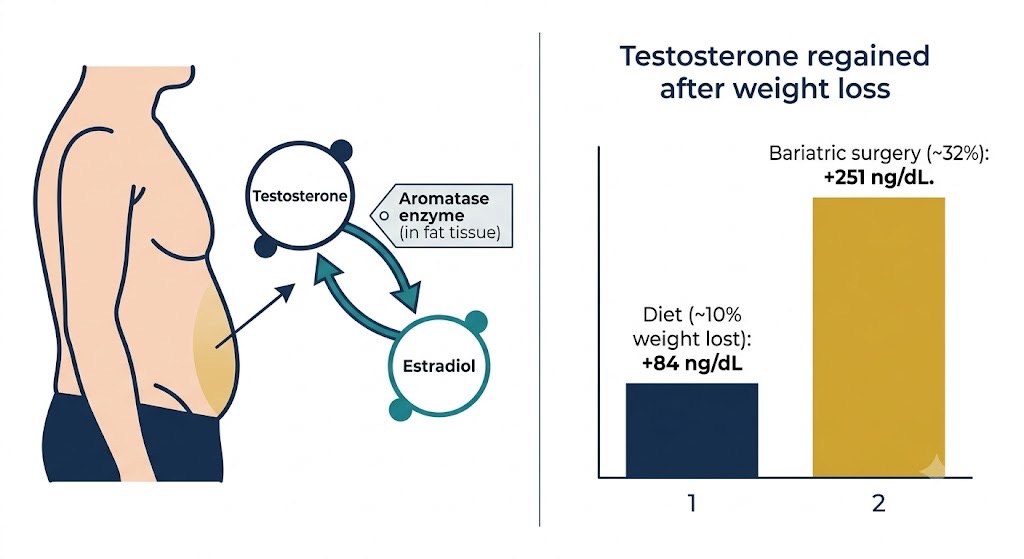
Fat tissue runs on aromatase, converting testosterone into estrogen. Losing weight reverses the process — and the more you lose, the more testosterone comes back.
3. Lift heavy — and eat enough fat to build hormones from
Resistance training's direct effect on resting testosterone is modest in isolation; its power is compounding, through the fat loss and lean mass it drives over months, both of which feed back into levers 1 and 2.6. Diet composition matters more than the low-fat orthodoxy of the 1990s admitted: testosterone is built from cholesterol, and very-low-fat eating can suppress it. Andrew Huberman has bluntly called that trend nutritional castration for the reproductive system.7 The practical version isn't butter by the stick — it's adequate dietary fat, sufficient protein, and enough total calories that the body doesn't down-regulate a system it treats as optional. Evidence-based physique coaches like Layne Norton and Eric Helms make the same point from the muscle side: chronic aggressive dieting flattens hormones, and food plus sleep is the recovery, not an afterthought to it.
Movement II — The supplements: signal versus noise
Only now, near the middle of the pyramid, do supplements earn their place — and the honest rule for the whole movement is: correct a deficiency or modestly nudge free testosterone, but don't expect a pill to do what the barbell and the bedroom didn't.
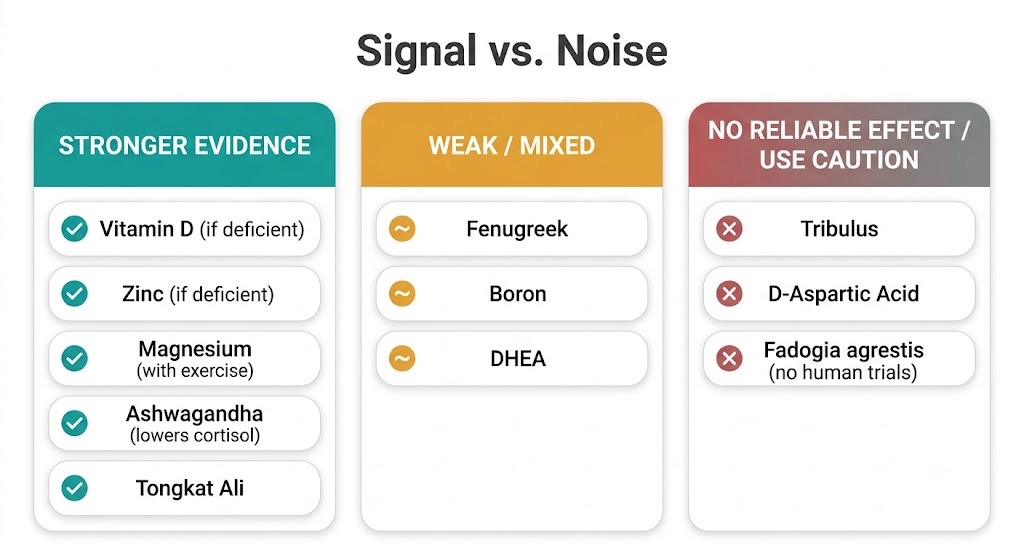
Not all boosters are equal. A short list has real human evidence — most matter only if you're deficient — while perennial sellers like Tribulus, and the unproven Fadogia, don't reliably move the needle.
4. Correct the deficiencies: vitamin D, zinc, magnesium
The rule that separates these three from the marketing around them is simple: they raise testosterone when you're deficient, and mostly not otherwise.8 A 2022 systematic review found zinc supplementation raised testosterone specifically in zinc-deficient men; vitamin D shows the same pattern; and magnesium appears most useful paired with exercise in already-active men.8 The actionable insight isn't "take all three." It's that a man with a vitamin D of 22 ng/mL has a real, fixable problem, while a man at 55 ng/mL is buying urine. Which supplement helps you is a question a blood test answers, and a label cannot.
5. Ashwagandha — the cortisol lever
Ashwagandha (Withania somnifera) works largely by lowering cortisol, the stress hormone that suppresses testosterone; drop the cortisol, and you release that brake. In a randomized, placebo-controlled trial of overweight, stressed adults, men on a standardized extract showed a significant rise in free testosterone and luteinizing hormone versus placebo.9 The population that benefits most is the chronically stressed one, which describes a great many of the executives reading this. Choose a studied extract (KSM-66 or Sensoril), not a "proprietary adaptogen matrix."
6. Tongkat Ali (Eurycoma longifolia) — the best-studied botanical
Among the herbs, Tongkat Ali has the most consistent human evidence. A 2022 meta-analysis of randomized trials found a significant increase in total testosterone in both healthy and hypogonadal men, mechanistically by lowering sex-hormone-binding globulin — which frees bound testosterone — and modestly inhibiting aromatase.10,11 Huberman, who uses 400 mg daily and tracks the effect with twice-yearly bloodwork, is a clean illustration of the disciplined way to run it: baseline, intervene, re-measure.12 Peter Attia adds the sourcing caveat that governs all unregulated botanicals — third-party purity testing (NSF, Informed Sport, USP, ConsumerLab) is the difference between a supplement and a mystery.13 The fair reservation: trials are small and some are industry-funded, so treat it as a reasonable add-on, not a guarantee.
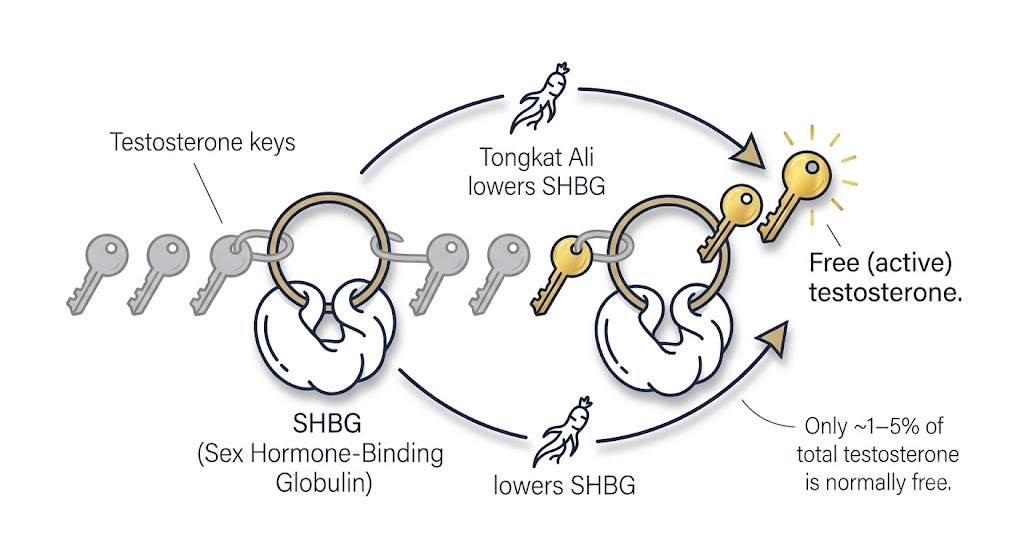
Most testosterone rides around bound to SHBG and is inactive. Botanicals like Tongkat Ali work largely by lowering SHBG, freeing more of the active hormone your tissues can actually use.
7. Fenugreek and boron — the SHBG modulators
Both operate, if at all, on sex-hormone-binding globulin: free the bound fraction and free testosterone rises even when total testosterone barely moves. Fenugreek shows modest gains in a handful of trials; boron can reduce SHBG acutely, though the human literature is genuinely conflicting — some trials show an effect, others none.10,14 Cheap, low-risk, modest, and — the recurring lesson — better measured than assumed.
Movement III — What to skip, and what to subtract
8. Ignore what doesn't work — and be wary of what's unwise
Truthfulness is the whole point of a research newsletter, so: several popular ingredients do not reliably raise testosterone in healthy men. Tribulus terrestris, marketed for decades, shows no consistent effect; D-aspartic acid failed to raise — and in one trial lowered — testosterone in trained men; DHEA is mixed and banned in sport.1,14 A sharper warning goes to Fadogia agrestis, the shrub that surged through podcasts: it has zero published human clinical trials for any outcome, several rat studies that showed testosterone gains also flagged testicular toxicity at higher doses, and — tellingly — the supplement company most associated with popularizing it quietly discontinued the product in 2023.15 Mechanistic enthusiasm is not evidence, and "it worked for a famous podcaster" is a testimonial, not a trial.
9. Remove the invisible suppressors
Some of the highest-yield moves are subtractions, not additions. Heavy alcohol suppresses the testicular axis. Unmanaged chronic stress keeps cortisol elevated (lever 5 in reverse). And a growing literature implicates environmental endocrine disruptors — a subject this newsletter has treated at length elsewhere — in the population-level pressure on male hormones.16 None of these costs a dollar; each is a decision.
Movement IV — The multiplier that makes it personal
10. Test, then personalize — the lever that governs the other nine
Every recommendation above has a responder population and a non-responder population, and you cannot tell which you are from a label. That single fact is why testing sits at the top of the pyramid: baseline your total and free testosterone, SHBG, LH, estradiol, vitamin D, and a metabolic panel; intervene; then re-measure and keep only what worked for you. An entire category of consumer platforms now exists to run exactly that loop, and they differ in instructive ways:
Anant Vinjamoori, then Superpower's chief longevity officer, framed the ambition as a system in which your data isn't just tracked; it's understood and acted on instantly.18 That is the right north star. The frontier question is whether we can go one step further, from measuring you to modeling you.
The genome beneath the number
Two men with identical testosterone can experience it completely differently, because the androgen receptor varies. A CAG-repeat sequence in the AR gene (typically 9–35 repeats) sets the receptor's sensitivity: more repeats, less sensitive, meaning more circulating testosterone is required to produce the same signal.19 This is not academic. In research presented at the Society for Endocrinology's 2025 meeting, men who failed to respond to testosterone therapy had significantly longer CAG repeats than responders (21.8 vs 18.7).20 The receptor, not just the hormone, decides the outcome — which is why a population-average protocol misfires so often at the individual level.
This is where genomics stops being a curiosity. Services such as The Genomics Company profile, from a saliva sample, how a person creates, converts, and clears hormones across seven physiological systems — the kind of durable baseline that explains why one man responds to boron and not fenugreek, or needs more dietary fat than his training partner.21 Layered onto bloodwork and wearable data, genetics turns a generic plan into a personal one.
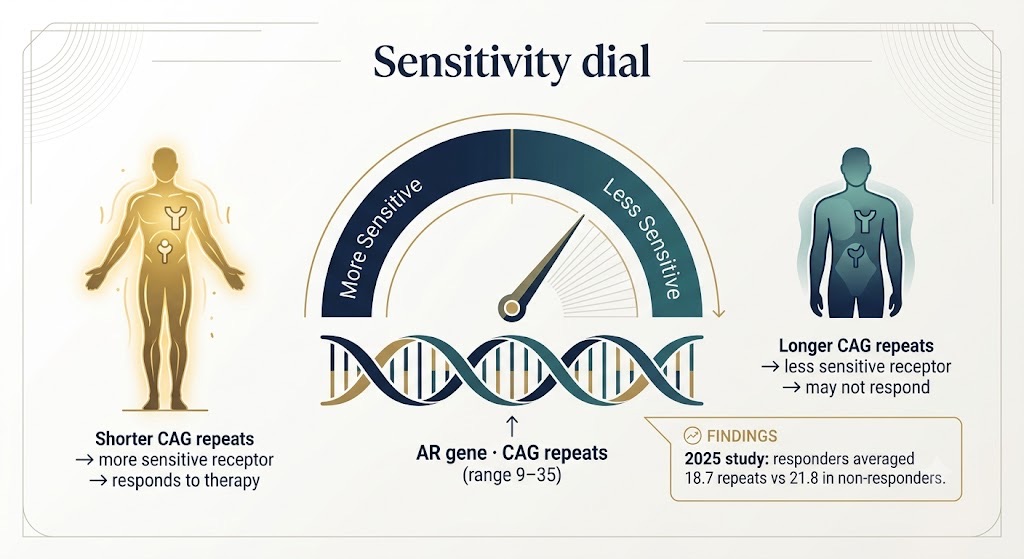
Two men with identical testosterone levels can feel completely different, because the androgen receptor's sensitivity is written in the genome. In one 2025 study, therapy non-responders carried noticeably longer CAG repeats than responders.
From measurement to prediction: the Digital Twin
Aggregate that multi-modal health data — genomic sensitivity, longitudinal labs, sleep, and recovery — and you can begin to build a computational model of one person's endocrine system: a Digital Twin for Predictive Peptide Performance™. The premise is simple. A model trained on your receptor sensitivity, your SHBG dynamics, and your response history can simulate an intervention before you spend three months discovering it doesn't suit you. That is the difference between predictive modeling and trial-and-error, and it is the same logic that lets a Coach / Practitioner and an Athlete / Patient iterate faster together, with fewer wasted cycles.
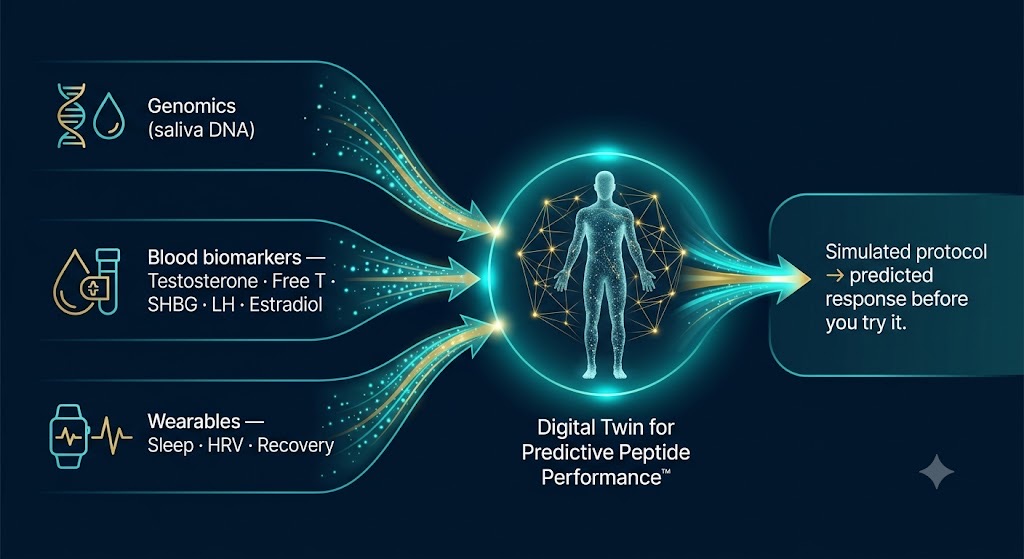
Combine genetics, longitudinal bloodwork, and wearable data, and you can model one person's endocrine system — testing an intervention in software before spending three months testing it on yourself.
When natural isn't enough: the honest medical boundary
For men with lab-confirmed hypogonadism, no botanical substitutes for medical care — and the safety picture for prescribed testosterone recently got clearer. The TRAVERSE trial, mandated by the FDA and run through a consortium led by AbbVie, randomized 5,204 middle-aged and older men with hypogonadism and elevated cardiovascular risk; testosterone therapy proved non-inferior to placebo for major adverse cardiac events.22 The authors — including Shalender Bhasin of Brigham and Women's Hospital, Peter Snyder, Mohit Khera of Baylor College of Medicine, and Thomas Travison — also reported more atrial fibrillation, pulmonary embolism, and acute kidney injury in the testosterone arm, cautions rather than footnotes.22
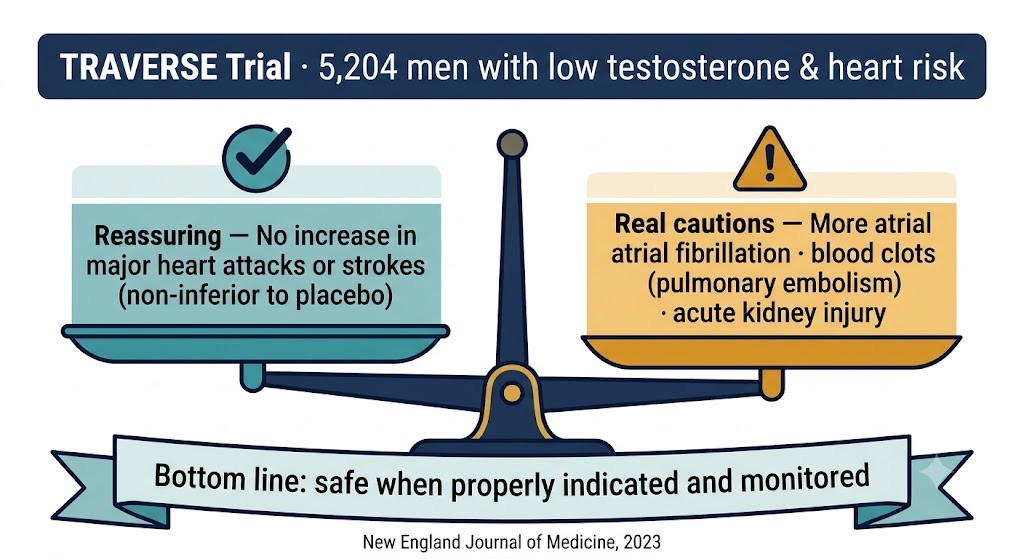
The largest trial of its kind found prescribed testosterone did not raise major cardiac risk in men who needed it — while flagging real cautions. The takeaway: a treatment for diagnosed deficiency, not a longevity supplement.
Abraham Morgentaler, reviewing the field for an Androgen Society position paper, called TRAVERSE a watershed moment.23 The operative phrase is properly indicated. Testosterone is a treatment for a diagnosed deficiency, not a longevity supplement to be taken because more feels better; and, as Endocrine Society guidance and Frederick Wu's work on the aging male emphasize, the first move for obesity-related low testosterone is usually to fix the obesity, not to prescribe the hormone.24 Between lifestyle and lifelong replacement sits an emerging middle — peptides such as gonadorelin and kisspeptin (the latter studied extensively by Channa Jayasena's group at Imperial College London) that stimulate the body's own production rather than replacing it. That Peptide Therapy is an active research area, not a settled consumer product, and it belongs inside a clinician relationship and a data system that can confirm it is actually helping.25
The through-line: precision beats potency
Rank the ten levers by evidence, and the same pattern the supplement aisle would rather you miss appears: the most powerful moves are free or nearly so, and the paid products sit lower, with honest, modest effects. What actually justifies spending money is not a bigger dose but better information — your baseline, your genetic sensitivity, and the discipline to re-measure.
That, in the end, is what longevity planning is. The people who stay strong, sharp, and metabolically young into their seventies are rarely the ones who found a magic molecule; they are the ones who treated their own physiology as a system worth measuring and managing, early and on purpose. LeBron James understood at 25 what most men learn at 55 — that the boring fundamentals, run consistently and tracked honestly, are what compound. Testosterone is simply one legitimate place to start practicing that discipline. Handled with data instead of hope, it is one of the more rewarding ones.
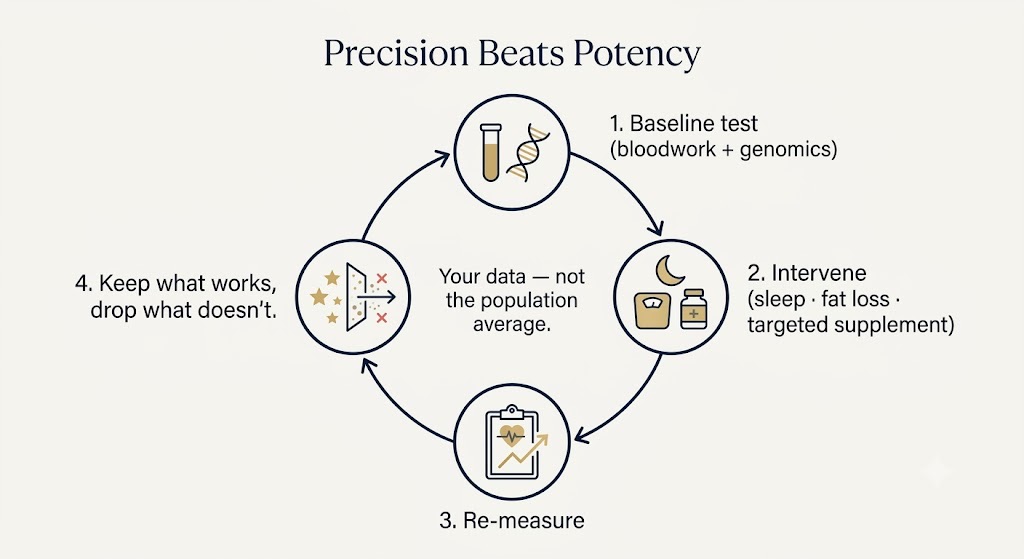
The habit that separates results from hope: baseline your bloodwork, change one thing, re-test, and keep only what worked for your body. That loop — not any single molecule — is what compounds into decades.
Sign up for FREE daily Longevity Club Workshops, or join the Affiliate Program (pays 20%).
About the Author
Tony Medrano is CEO and co-founder of LongevityPlan.AI, a platform that integrates performance and health data and leverages proprietary Digital Twin for Predictive Peptide Performance™ technology, wearable data, and biomarker data to deliver personalized optimization and longevity recommendations. A 3x technology/AI company CEO with 2 successful exits, Tony has completed 3 Full Ironman Triathlons (140.6 mi) since 2019. He holds degrees from Harvard University, Columbia University, and a JD/MBA from Stanford University, and has worked with the US Olympic Team, the NBA, NFL, MLB, NASA, Google, Microsoft, and Netflix, among others. He also served as a US Navy Officer commanding an emergency response team aboard a destroyer.
Tobias Young is an IFBB Pro, fitness business coach, author, and entrepreneur with more than 26 years in the fitness industry and over 16 years of online coaching experience. He is the founder of TNT Fit Pro Coaching and the creator of Fit Pro Solution and My Trainer Connect, author of The Online Success Blueprint, and host of The Fit Biz Accelerator Podcast.
Disclaimer: This article is for educational purposes and is not medical advice, diagnosis, or treatment. Supplement, testosterone, peptide, and hormone decisions should be made with a qualified clinician who can interpret your individual results.
Endnotes
- Mito Health, "Best Testosterone Booster: Evidence-Based Supplements Compared," 2026. mitohealth.com/guide/which-testosterone-booster
- University of Chicago Medicine, "Sleep loss lowers testosterone in healthy young men" (testosterone declines ~1–2%/yr with age). uchicagomedicine.org
- Leproult R, Van Cauter E. "Effect of 1 Week of Sleep Restriction on Testosterone Levels in Young Healthy Men," JAMA 2011;305(21):2173–4. PMC4445839; Van Cauter quote via UChicago Medicine (ref. 2).
- Fortune, "LeBron James reportedly spends $1.5 million a year on his biohacking regimen" (Mancias & James on sleep as the top, free recovery tool). fortune.com; TIME, "Try LeBron James' Post-Game Recovery Strategies" (recovery-pyramid framing; 8–10 hrs/night; still elite at 40). time.com
- Corona G, et al. "Body weight loss reverts obesity-associated hypogonadotropic hypogonadism," Eur J Endocrinol 2013;168(6):829. academic.oup.com; "The male hormone reset: GLP-1RAs, lifestyle and testosterone," Aging Male 2025. tandfonline.com
- "Impact of Weight Loss on Testosterone Levels: A Review of BMI and Testosterone," PMC 2024. PMC11745839
- Huberman A., remarks on dietary fat and testosterone ("nutritional castration"), summarized at readandrewhuberman.com. readandrewhuberman.com
- Rupa Health, "Supplements to Boost Testosterone Levels," 2025. rupahealth.com; Whole Men's Health, "Supplements That Actually Boost Testosterone." wholemenshealth.com
- Lopresti A, et al. "Novel standardized ashwagandha (Witholytin) in adults with high stress and fatigue," RCT, PMC. PMC10647917
- "Testosterone Boosters Intake in Athletes: Current Evidence" (Tongkat Ali, ashwagandha, and fenugreek strongest-evidence botanicals; boron/L-arginine conflicting). semanticscholar.org (PDF)
- "Eurycoma longifolia (Jack) Improves Serum Total Testosterone in Men: A Systematic Review and Meta-Analysis of Clinical Trials," PMC (SHBG reduction and aromatase inhibition mechanism). PMC9415500
- "Andrew Huberman Testosterone Supplements List" (400 mg Tongkat Ali daily; twice-yearly blood testing via Function). fastlifehacks.com
- Attia P. / Huberman A. on supplement sourcing and third-party testing, summarized at readandrewhuberman.com. readandrewhuberman.com
- GoodRx, "Supplements That Increase Testosterone" (Tribulus without consistent effect; DHEA mixed). goodrx.com
- Thrive, "The Andrew Huberman Testosterone Protocol: 2026 Evidence-Based Analysis" (Fadogia agrestis: zero human trials; rat testicular-toxicity signals; discontinued by its primary retail partner in 2023). trythrive.app
- Medrano T., "Invisible Estrogen Effects and Dangers: Mold, Metals, and Your Tap Water," LongevityPlan.AI. longevityplan.ai
- Fin vs Fin, "Function Health vs Superpower vs InsideTracker vs Lifeforce (2026)." finvsfin.com; Superpower biomarker list. superpower.com/biomarkers
- Vinjamoori A. (Chief Longevity Officer, Superpower), quoted in Fierce Healthcare, "New startup Superpower scores $30M." fiercehealthcare.com
- "Influence of CAG Repeat Polymorphism on the Targets of Testosterone Action," PMC. PMC4572434
- "Androgen receptor sensitivity assessed by genetic polymorphism in the testosterone treatment of male hypogonadism," Society for Endocrinology BES 2025 (non-responders mean CAG 21.8 vs responders 18.7; p=0.03). endocrine-abstracts.org
- The Genomics Company, saliva-based genomic profiling across seven physiological systems including hormones and detoxification. thegenomicscompany.com
- Lincoff AM, Bhasin S, et al. "Cardiovascular Safety of Testosterone-Replacement Therapy" (TRAVERSE), N Engl J Med 2023;389(2):107–117. nejm.org
- Morgentaler A, et al. "Androgen Society Position Paper on Cardiovascular Risk With Testosterone Therapy," Mayo Clinic Proceedings 2024. mayoclinicproceedings.org
- Bhasin S, et al. "Testosterone therapy in men with hypogonadism: an Endocrine Society clinical practice guideline," J Clin Endocrinol Metab 2018; and approach-to-the-patient review on low testosterone in obesity. academic.oup.com
- Jayasena CN, et al., kisspeptin and reproductive-axis research, Imperial College London (referenced in TRTed clinical review of TRAVERSE). trted.org